
From before and through the print era to today’s digital world, libraries and other cultural memory organizations have preserved data, information, and more for centuries, which is critically important work especially in times of major transition. As the Michigan Digital Preservation Network (MDPN), the world’s first production LOCKSS (Lots of Copies Keeps Stuff Safe) 2.0 network, celebrated its official launch with a virtual ribbon-cutting ceremony on March 12, I’m reflecting on the work that got us here, which began over 25 years ago with the foundation that Victoria Reich and David S.H. Rosenthal laid in creating LOCKSS. Vicky and David were awarded the Paul Evan Peters Award at the Coalition for Networked Information Spring 2025 Membership Meeting, and spoke about the early history of the software that powers MDPN as well as InDiPres in Indiana and so many other digital preservation networks.
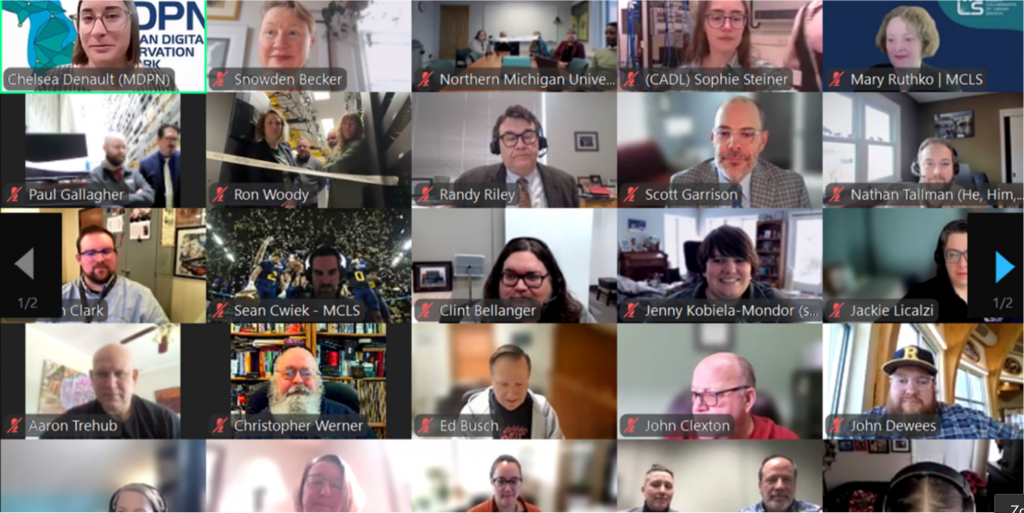
Some participants in the MDPN’s virtual ribbon-cutting celebration on March 12, 2025. (Photo credit: Snowden Becker)
In the early transition from print to electronic journals in the 1990s (spurred in part by Highwire Press at Stanford), librarians and others became concerned about how to preserve digital content. Vicky and David originally conceived LOCKSS to model the way that paper worked to provide libraries with an easy, familiar, affordable way to build and steward traditional collections that were migrating from paper to online. Stewardship is important in ensuring future access and protecting user privacy (as well as the first sale doctrine in copyright law), and it is also important in defending against censorship and protecting ownership transfer when content is acquired. As with print, libraries need a way to hold multiple electronic copies under multiple stewards to resist censorship for material such as government documents, research data, and banned books.
In Vicky and David’s CNI lecture, Vicky spoke about the evolution from the Federal Depository Library Program to the Digital Federal Depository Library Program (or “USDocs” LOCKSS network) and the Internet Archive’s Wayback Machine. The biggest threat to digital preservation is insider attack, and the antidote is multiple copies under multiple stewards – that makes it “easy to find some of the copies, but hard to find all of the copies.” She also covered the evolution of Private LOCKSS Networks (PLNs) including CLOCKSS (Closed LOCKSS), an international network that archives journals. Another key feature of LOCKSS is to allow libraries to cooperate as they have for decades via strategies including interlibrary loan and shared print storage, at an international scale.
David explained the technical details of why he and his team built LOCKSS the way they did, noting that given a limited budget and a range of threats, data survives better in many cheap, unreliable, loosely-coupled replicas than in a single expensive and durable one. LOCKSS is more resistant to attack, resists acquisition (such as happens with commercial publishers and others), and operates at scale at a cost that can be spread across multiple organizations’ budgets. LOCKSS nodes communicate with each other to ensure that copies of data that become corrupted can be replaced with a correct copy from the network. David sees LOCKSS as a better solution than hyperscalers such as Amazon’s Glacier service for the cost. MDPN took a risk betting on the rearchitected LOCKSS 2.0 rather than commercial solutions, and that bet is certainly paying off. Good things really do come to those who wait.
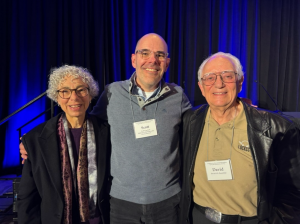
MCLS Executive Director Scott Garrison with 2025 Paul Evan Peters Award winners Victoria Reich and David Rosenthal, creators of LOCKSS (Photo credit: Martin Halbert)
After Vicky and David’s lecture, I told Vicky that MDPN is the first LOCKSS 2.0 production network. Her eyes lit up, and she asked, “Really?” “Yes,” I replied. “Really.”
There are so many people to thank for that fact, beginning with Vicky and David.
Also, at CNI, LOCKSS Program Community Manager Snowden Becker and a panel presented on MetaArchive, the first and longest-running PLN, which has given way to a new group of PLNs including MDPN. In detailing its history, panelists described MetaArchive as a commitment to abundance in a mutual aid approach based on trust.
Snowden emphasized that LOCKSS networks own their network and can learn and do, and build sweat equity, staff talent, and “insourced” capacity with a community-based solution. That approach has been a hallmark of the MDPN community, and it continues to be a joy to see. The group also talked about how to sustain a network through a business lens, with dedicated resources including staff and time. They pointed out that community-based solutions that include people in decision-making are much better for the longer term, and that short-term convenience can evolve into longer-term inertia in terms of just renewing a contract that may be at risk of inflation, market consolidation, and other forces, rather than going through some pain for greater long-term gain.
The panel also discussed the importance of being transparent and clear about what a network’s members will get at what cost and by what governance and funding model, as well as the need for robust ingest methods, contingency plans, and documentation. The MDPN community has worked hard to create much of this fuel to sustain the Network, and there is more work to do.
Snowden kindly cited MDPN as a good and collaborative model. At the virtual ribbon-cutting (which she also summarized), I had the opportunity to thank all those who have made it so, beginning with Grand Valley State University, the Library of Michigan, MCLS, Michigan State University, and Western Michigan University, who originally conceived the MDPN, to Dr. Chelsea Denault, the MDPN Coordinator, and other MCLS staff who have supported the work, our node hosts, those who have participated in building the community, and those who work with Chelsea to ensure that MDPN serves as “one leg of the three-legged digital collection stool” along with digitization and access. I am also very thankful for the Institute of Museum and Library Services’ support for MDPN, which has been key to bringing up the Network.
Before I close, I need to thank one more person: CNI Executive Director Clifford Lynch, who passed away on April 10.
Cliff made many contributions to the digital preservation landscape, and he figured prominently in Vicky and David’s story. Over my 31-year career working in and for libraries, I have had the frequent privilege of hearing Cliff speak eloquently on a wide variety of topics related to information technology, public policy, and more. I was saddened to learn that we lost Cliff just after the CNI Spring 2025 meeting, and appreciate how Vicky, David, and many others have spoken and written about his countless contributions to libraries and the broader information landscape. If you’re not familiar with Cliff’s work, I hope you’ll learn more about this kind, generous, articulate, and inspiring person whom we lost too soon. Michael Upshall, Community and Outreach Manager at Core, did a wonderful interview with Cliff in the Against the Grain podcast on September 8, 2024 (video on YouTube). I recommend it highly.
Thank you as always for reading. If you would like to learn more about MDPN, please visit mipres.org. If you have an idea or question about how MCLS could help your library, contact me anytime at garrisons@mcls.org.
Fall conference and event season is just around the corner, and I encourage you to engage with MCLS staff and Board of Directors members when our paths cross this fall.
In September, we’ll have staff and Board members at the following conference:
Upper Peninsula Region of Library Cooperation Annual Conference (Sept. 21-22)
In October, find us at the following conferences and events:
Association for Library Service to Children National Institute (Oct. 1-3)
MCLS Members Annual Event (Oct. 9 – list below subject to change)
Michigan Museums Association Annual Conference (Oct. 19-21)
MCLS Board of Directors Meeting and Retreat (Oct. 25-27)
Michigan Library Association Annual Conference (Oct. 28-30)
Michigan Association of School Librarians Annual Conference (Oct. 28-30)
In November, we hope to see you at the following conferences and events:
Charleston Conference (Nov. 3-6)
Indiana Library Federation Annual Conference (Nov. 8-10)
Michigan OER Network Conference (Nov. 13)
Finally, please save the date for the MCLS Annual Meeting: Tuesday, Dec. 8 at 10 a.m. Eastern (9 a.m. Central) online via Zoom. Watch your email for registration information, and we’ll look forward to seeing you there.
Our staff work hard representing MCLS at these and other conferences and events. We hope to see you and connect. Until then, contact me anytime at garrisons@mcls.org.
Have a question, idea, or story to share? Let us know!
As usual, it’s a very busy time at MCLS as we close one fiscal year (FY) and begin another. Here are some updates about what’s happening as we move from FY2026 to FY2027.
Midwest Collaborative for Library Services exists so that:
Libraries can benefit by gaining expanded access to resources, innovative and stable library services, and collaborative efforts, worth the continuing investment of members and affiliates.
Our Board used data from their 2025 survey of MCLS members to create this statement, the first major revision to the Board’s vision for MCLS since November 2017. The staff and I have already begun operationalizing elements of it as part of implementing the current MCLS strategic plan and we’ll have much more to say about that in future MCLS newsletters.
Our dedicated staff are hard at work on a variety of other projects including considering new vendors and products for our eLicensing program, adding new training members have requested, continuing to improve our accounting and financial processes and infrastructure, preparing to launch a new MCLS website, and many more. Together, we work to help libraries, partner organizations, and community initiatives grow and thrive however possible.
How does or could MCLS help your library? Let me know at garrisons@mcls.org.
Recently, MCLS worked with EveryLibrary Institute and a team of students from the University of Michigan-Ann Arbor School of Information (UMSI) on a research project about the positive impact libraries make for each citizen on their lifelong learning and literacy journey. The project originated from summer 2025 discussions about how library associations and organizations could support Indiana and Michigan libraries collaboratively in a time of major disruptions and threats to library funding. Given different needs in each state, MCLS partnered on the project I describe below to focus on Michigan, and on a separate project focused on Indiana that is currently underway.
I thank Lisa Waskin (MCLS Board of Directors, Superior District Library), John Chrastka (EveryLibrary Institute), Lori Donovan, Kristin Fontichiaro, and Anthea Josias (UMSI) for their work to conceive and support our project. Most importantly, I thank our UMSI SI699 student team, Madeline Brookman, Ellie Franklin, and Sofia Frumkin, for all their work on the research and documents they produced (including an annotated bibiography, a course paper, a white paper, and a poster they presented at the UMSI Student Project Exposition on April 20).
Following summer 2025 meetings between library association leaders, John, and myself, a group of Michigan library leaders and EveryLibrary Institute agreed on a need for data that can support other work to help libraries demonstrate their positive impact (such as developing policy briefs and other information). Through other conversations in fall 2025, UMSI approached our group about proposing a student research project for their SI699 Mastery Course, and we agreed to submit. Lisa drafted a project proposal in consultation with John and me. By early January, UMSI had accepted our proposal and it had been selected by our student team. John, Madeline, Ellie, Sofia, and I began meeting as a project team, and John created a work plan to guide the students’ work framed around the following elements:
Our project team agreed that the main project deliverables would be an annotated bibliography and an SI699 course paper. The students also decided to create a short white paper summarizing their findings and conclusions with references (in addition to a poster for the exposition).
As their semester ramped up, our student team began an iterative approach to search the literature and find data from various Michigan state agencies and organizations, national resources, and foundations, with advice from John, help from UM-Ann Arbor Education Liaison Librarian Karen Downing and retired school librarian Kathy Lester, and frequent communication with each other. They also found a February announcement about literacy investments in Michigan Governor Gretchen Whitmer’s proposed FY2027 budget, which does not mention funding for libraries.
Some of the student team’s key data findings were as follows (see references list below):
In the course of their research, our student team came to recognize how vital libraries are for people’s development and success in their communities. Their course paper conclusion noted that:
When libraries are well funded, their patrons are able to access countless resources, participate in civic engagement, and grow academically and socially. School libraries, public libraries, and university libraries…are all integral to the improvement of literacy rates… When libraries have increased numbers of qualified staff, larger collections, more resources, and are open for more hours, users are consequently more successful academically… Furthermore, library programs can be used for more specific scenarios for Michigan residents, including building up financial literacy and independence, as well as opportunities for learning and advancement for incarcerated populations (Brookman, Franklin, & Frumkin, SI699 course paper pp. 11-12).
The students recommend strongly that Michigan provide more funding for libraries and see a significant opportunity given Governor Whitmer’s literacy priority. They also offered other advice to MCLS and EveryLibrary Institute, including looking beyond literacy in future work about the library’s benefits, monitoring political trends in Michigan and other midwestern states, and conducting primary research with library users.
Moving forward from this great opportunity to work with enthusiastic and energetic students and EveryLibrary Institute, MCLS will continue pursuing opportunities to gather and share information about the positive impacts that libraries make for people across all stages of life. If you would be interested in learning more or getting involved, please let me know. We are interested in doing a similar project focusing on Indiana.
I am always open to hearing ideas for how MCLS can support libraries. I hope to hear from you soon at garrisons@mcls.org.
References
